Cu ocazia evenimentului Noaptea Muzeelor 2023, Muzeul Universității din București a pregătit expoziția fizică O călătorie prin istoria învățământului de Științe de la Universitatea din București (1863-1948), constituită din zece panouri, completată de o expoziție digitală, și de mai multe exponate în vitrine și un stand unde se putea descoperi o „lume” minusculă printr-un microscop.
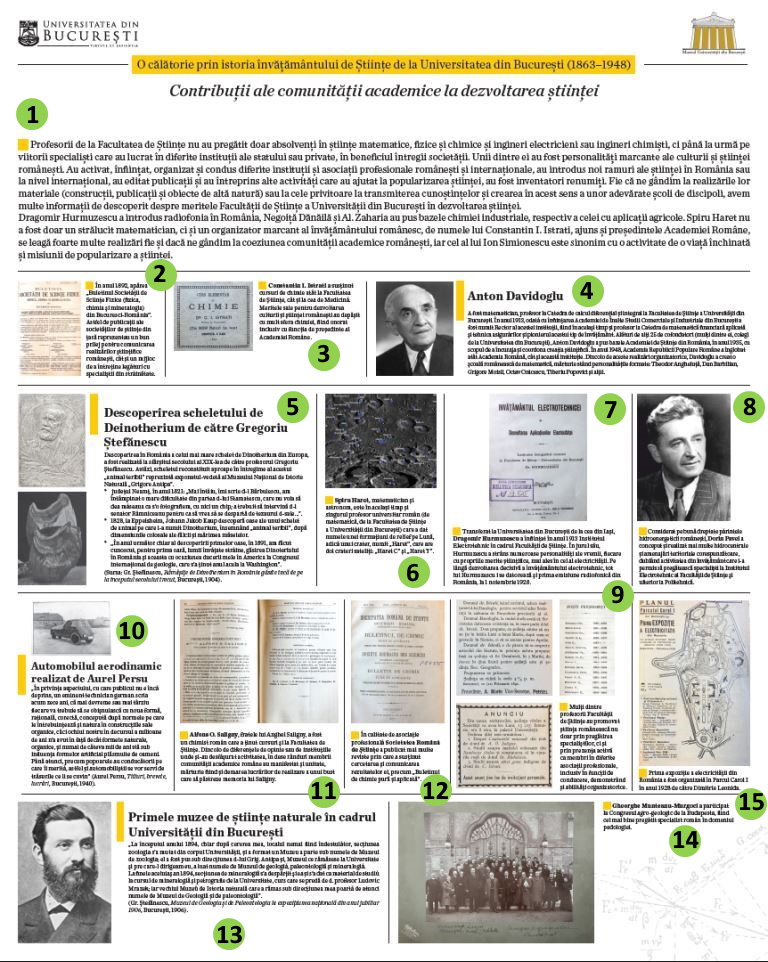
În această pagină vă prezentăm Panoul 9: Contribuții ale comunității academice la dezvoltarea științei.
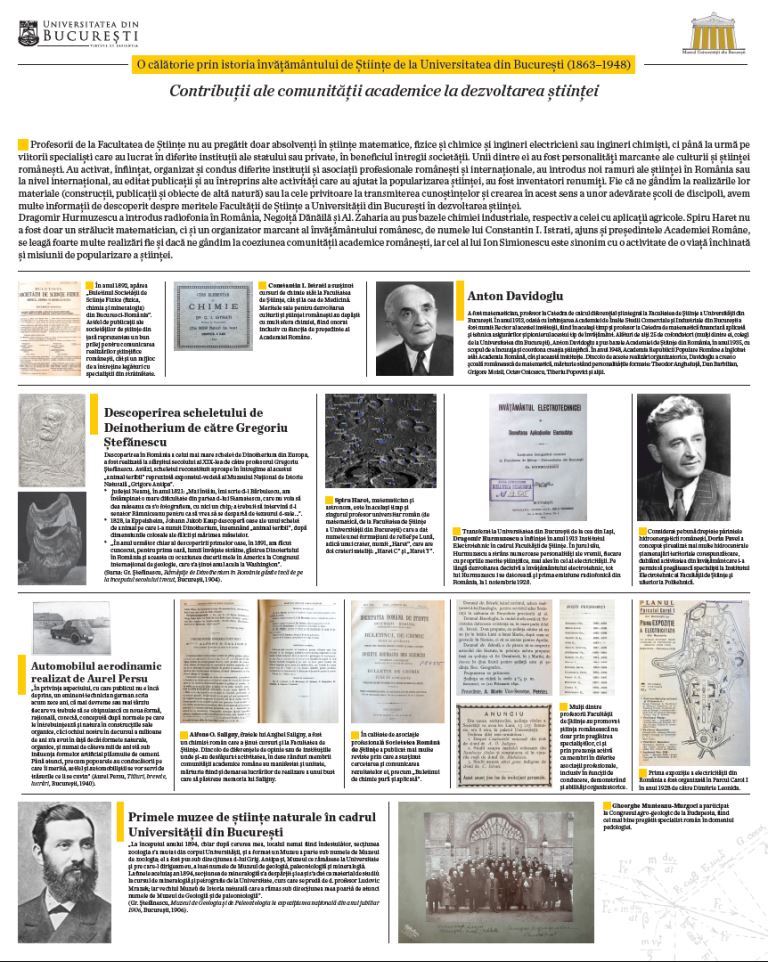
Selectiv, prezentăm câteva din textele și imaginile acestor panouri, dar reamintim că o parte dintre ele pot fi descoperite (împreună cu documente noi și inedite) și în această expoziție digitală.
*
Profesorii de la Facultatea de Științe nu au pregătit doar absolvenți în științe matematice, fizice și chimice și ingineri electricieni sau ingineri chimiști, ci până la urmă pe viitorii specialiști care au lucrat în diferite instituții ale statului sau private, în beneficiul întregii societății. Unii dintre ei au fost personalități marcante ale culturii și științei românești. Au activat, înființat, organizat și condus diferite instituții și asociații profesionale românești și internaționale, au introdus noi ramuri ale științei în România sau la nivel internațional, au editat publicații și au întreprins alte activități care au ajutat la popularizarea științei, au fost inventatori renumiți. Fie că ne gândim la realizările lor materiale (construcții, publicații și obiecte de altă natură) sau la cele privitoare la transmiterea cunoștințelor și crearea în acest sens a unor adevărate școli de discipoli, avem multe informații de descoperit despre meritele Facultății de Științe a Universității din București.
Dragomir Hurmuzescu a introdus radiofonia în România, Negoiță Dănăilă și Al. Zaharia au pus bazele chimiei industriale, respectiv a celei cu aplicații agricole. Spiru Haret nu a fost doar un strălucit matematician, ci și un organizator marcant al învățământului românesc, de numele lui Constantin I. Istrati, ajuns și președintele Academiei Române, se leagă foarte multe realizări fie și dacă ne gândim la coeziunea comunității academice românești, iar cel al lui Ion Simionescu este sinonim cu o activitate de o viață închinată și misiunii de popularizare a științei.
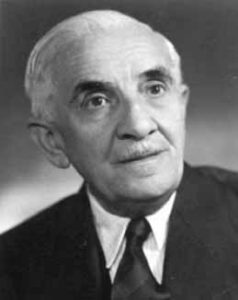
Anton Davidoglu a fost matematician, profesor la Catedra de calcul diferențial și integral la Facultatea de Științe a Universității din București. În anul 1913, odată cu înființarea Academiei de Înalte Studii Comerciale și Industriale din București a fost numit Rector al acestei instituții, fiind în același timp și profesor la Catedra de matematică financiară aplicată și tehnica asigurărilor și pionierul acestui tip de învățământ. Alături de alți 25 de cofondatori (mulți dintre ei, colegi de la Universitatea din București), Anton Davidoglu a pus bazele Academiei de Științe din România, în anul 1935, cu scopul de a încuraja și coordona creația științifică. În anul 1948, Academia Republicii Populare Române a înglobat atât Academia Română, cât și această instituție. Dincolo de aceste realizări organizatorice, Davidoglu a creat o școală românească de matematică, mărturie stând personalitățile formate: Theodor Angheluță, Dan Barbilian, Grigore Moisil, Octav Onicescu, Tibeiu Popovici și alții.
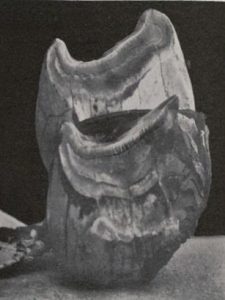
Descoperirea scheletului de Deinotherium de către Gregoriu Ștefănescu
Descoperirea în România a celui mai mare schelet de Dinotherium din Europa, a fost realizată la sfârșitul secolului al XIX-lea de către profesorul Gregoriu Ștefănescu. Astăzi, scheletul reconstituit aproape în întregime al acestui „animal teribil” reprezintă exponatul-vedetă al Muzeului Național de Istorie Naturală „Grigore Antipa”.
* județul Neamț, în anul 1821 : „Mai întâiu, îmi scrie d-l Bărbulescu, am întâmpinat o mare dificultate din partea d-lui Stamatescu, care nu voia să dea măseaua ca s’o fotografiem, cu nici un chip; a trebuit să intervină d-l senator Râmniceanu pentru ca să vrea să se despartă de tezaurul d-sale…”.
*1828, la Eppelsheim, Johann Jakob Kaup descoperă oase ale unui schelet de animal pe care l-a numit Dinotherium, însemnând „animal teribil”, după dimensiunile colosale ale fălcii și mărimea măselelor.
* „În anul următor chiar al descoperirii primelor oase, în 1891, am făcut cunoscut, pentru prima oară, lumii învățate străine, găsirea Dinoteriului în România și aceasta cu ocaziunea ducerii mele în America la Congresul internațional de geologie, care s’a ținut anul acela la Washington”.
(Sursa: Gr. Ștefănescu, Rămășițe de Dinotherium în România găsite încă de pe la începutul secolului trecut, București, 1904).
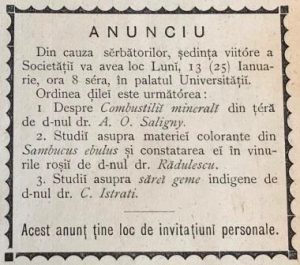
Ședințe ale Societății de Științe din România au fost organizate și în Palatul Universității din București, mult timp una dintre cele mai impresionante construcții din București. Mulți dintre profesorii Facultății de Științe erau și membri ai societăților de științe din țară, dar și din străinătate, reprezentând România la diverse evenimente științifice.
*
EN
Panel 9: Contributions of the Academic Community in the Development of Science
1.
The professors that were part of the Faculty of Sciences from the University of Bucharest did not only train graduates in the fields of mathematics, physics, chemistry or chemical and electrical engineers, but also the future specialists that worked in the various institutions that were part of the State or private sector and proved to be a benefit to the whole society. Some of them were grand personalities of the Romanian culture and science. They worked, organised and led various institutions and professional associations, be they Romanian or international. They brought new fields of science in Romania or on a global scale, they edited publications or were famous inventors and they popularised science through their other activities. Be it their material realisations (buildings, publications or other objects) or the rendering of knowledge through their schools, we have many more things to discover about the merits of the Faculty of Sciences in its quest to develop science.
Dragomir Hurumuzescu introduced radios in Romania, Negoiță Dănăilă and Alexandru Zaharia built the foundation on which industrial and agricultural chemistry developed. Spiru Haret was not only a brilliant mathematician, but also a fabled organiser of the Romanian educational system. Constantin I. Istrati, who would become president of the Romanian Academy, has many realisations to speak of, even if we only think about the linking together of the whole Romanian academic community, while Ion Simionescu’s name is synonymous with a life-long activity dedicated to the popularisation of science.
2.
In 1892 the „Bulletin of the Physical Sciences of Bucharest – Romania” was released. This kind of publication of the scientific societies from Romania represented a good opportunity for the propagation of scientific realisation as well as a medium to maintain links to specialists abroad.
3.
Constantin I. Istrati held chemistry courses at both the Faculty of Sciences and the Faculty of Medicine. His merits for developing the Romanian culture and sciences exceeded the sphere of science itself, being ultimately honoured with a prestigious function – the president of the Romanian Academy.
4.
Anton Davidoglu.
He was a mathematician and professor at the Differential and Integral Calculus at the Faculty of Sciences. In 1913, the year that marked the founding of the Romanian Academy of Higher Comercial and Industrial Studies of Bucharest (now the Academy of Economical Studies of Bucharest) he was named as rector of the institution as a whole, being also a professor in the Department of Applied Financial Mathematics and the Insurance Techniques and a pioneer in this field of education. Alongside the other 25 co-founders (many of them being his peers at the University of Bucharest), Anton Davidoglu founded the Romanian Science Academy (not to be mistaken for the older Romanian Academy) in 1935 to encourage and coordinate scientific creation. In 1948 the Academy of the Popular Romanian Republic integrated both this new institution and the Romanian Academy. Beyond his organising realisations, Davidogly also created a Romanian mathematical school, proof of which was the training of the following personalities: Theodor Angheluță, Dan Barbilian, Grigore Moisil, Octav Onicescu, Tiberiu Popovici and many others.
5.
The discovery of the Deinotherium skeleton by Gregoriu Ștefănescu
The discovery of the greatest Deinotherium skeleton of Europe in Romania was made by Professor Gregoriu Ștefănescu at the end of the 19th century. Today, the complete reconstruction of this „terrible animal” represents the most important exhibit of the Grigore Antipa Natural History Museum.
* Neamț county, 1821: „First of all, Mr Bărbulescu writes me that he met a great difficulty from Mr. Stamatescu, who did not want to give the molar over to have photographies taken whatsoever. Mr senator Râmniceanu had to intervene because he did not want to break up with his treasure…”.
* In 1828, at Eppelsheim, Johann Jakob Kaup discovered the bones of an until-then undiscovered animal, baptising it by the name of Dinotherium, meaning ”terrible animal”, judging by the colossal size of its maw and its molars.
*„In the following year that elapsed from the first discoveries of the bones, 1891, we heralded the news for the first time to the international scholarly community: the discovery of the Dinoterium in Romania, being made with the occasion of my participation at the International Geology Congress held in Washington”.
(Source: Gr. Ștefănescu, Dinotherium Remains from Romania discovered even at the start of the last century, București, 1904).
6.
Spiru Haret, mathematician and astronomer, at the same time the only professor from the universities of Romania who gave his name to a set of moon relief formations, namely a crater, named Haret, which has two satellite craters: Haret C and Haret Y.
7.
Transferred at the University of Bucharest from Jassy, Dragomir Hurmuzescu founded the 1913 Electrotechnical Institute at the Faculty of Sciences. Around it, Hurmuzescu gathered various personalities of his time, each and every one of them having their scientific achievements, especially in the field of electrical studies. Besides the decisive evolution of electrotechnical education, Hurmuzescu is also credited for the first radio emission from Romania, at the date of 1 November 1928.
8.
Rightly considered the father of Romanian hydro-energy, Dorin Pavel, he also came up with and realised several hydropower plants and special spots for them. He doubled his teaching activity by preparing specialists in the field at the Electrotechnical Institute of the Faculty of Sciences and later at the Politechnical School.
9.
Many of the professors that activated at the Faculty of Sciences also promoted Romanian science not only through the training of specialists, but also through the activity as members of various professional associations. These included leading functions, and showing their organising capabilities.
10.
The aerodynamic automobile was made by Aurel Persu. „Judging from its aspect, of which the wide public isn’t quite yet acquainted with, an eminent German technician was writing 10 years ago that sooner or later they will have to come to terms with the new shape: rational, correct, made following the norms that fit and nature in its organic construction; as our eyes have only seen natural forms in the last millions of years, being acquainted with the anthropic forms in the last thousands of years. Until then, in the likeness of the people that have leaders that they deserve, in the same way, the automobile users will use the traits that they deserve” (Source: Aurel Persu, Titluri, breve, lucrări, București, 1940).
11.
Alfons O. Saligny, the brother of Anghel Saligny, was a Romanian chemist that also held courses at the Faculty of Sciences. Beyond the opinion or institutional differences that separated the academic community, they also showed unity proven by the work and time put into realising a bust to maintain the memory of Saligny.
12.
In its quality as a professional association, the Romanian Society of Sciences published several scholarly magazines that sustained constant research and communications regarding the results of said research. One of these is the „Bulletin of Pure and Applied Chemistry”.
13.
The first natural science museums from the University of Bucharest
„At the beginning of 1894, after my said application, the place being insufficient, the zoology section moved from the University building, forming a museum bearing the name of Museum of Zoology, being put under the administration of Mr Grigore Antipa and, the museum that remained in the University and under my own jurisdiction took the name of Museum of Geology, Paleontology and Mineralogy. At the end of the same year, 1894, the mineralogy section was also separated and was offered as study material at the university course regarding mineralogy and petrography which was taught by professor Ludovic Mrazek, the old natural history museum that remained under my administration bearing even from that time the name of Museum of Geology and Paleontology”.
(Source: Gr. Ștefănescu, Muzeul de Geologie și de Paleonologia la expozițiunea națională din anul jubiliar 1906, București, 1906).
14.
Gheorghe Munteanu-Murgoci participated at the agro-geological congress from Budapest, being the best-prepared specialist Romanian in the pedological field.
15.
The first exhibition of electricity in Romania was organised in the Carol I Park. It was held in 1928 by Dimitrie Leonida.
[English translation: Rareș Moise]

